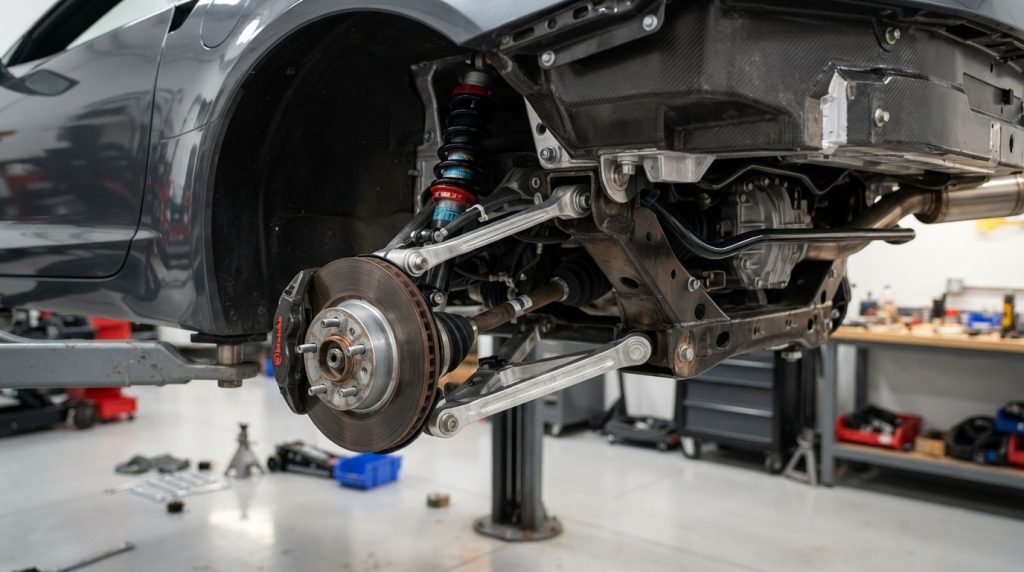
Independent suspension gives each wheel a degree of freedom to respond to the ground without forcing the wheel on the opposite side of the vehicle to follow the same movement. On broken pavement, gravel, or rocky trails, that separation can help maintain road contact, preserve traction, and keep steering responses more consistent.
The advantage is not simply a softer ride: it comes from how suspension travel, wheel articulation, and damping work together as the surface changes. Understanding those relationships explains why independent suspension can improve wheel control on uneven surfaces, while also showing where its design and setup influence handling, comfort, and off-road performance.
Independent suspension and individual wheel movement
In an independent system, each wheel is connected to the chassis through its own set of components, such as control arms, links, springs, and dampers. When one wheel rises over a bump, the other can remain closer to its previous position instead of being directly lifted or lowered with it.
This arrangement lets the suspension respond to smaller, more frequent changes in the ground. The result depends on geometry and tuning, but independent movement gives engineers more ways to manage how each tire meets the surface.
Wheel articulation across changing terrain
Wheel articulation describes how far and how freely a wheel can move vertically relative to the vehicle body. As one tire climbs a ridge or drops into a shallow depression, independent suspension allows that corner to move without requiring the opposite wheel to mirror it.
That freedom can reduce unwanted body movement and help the tires follow irregular ground. The benefit is particularly noticeable when the wheels encounter obstacles at different heights, because the suspension can respond locally rather than treating the axle as a single rigid unit.
Suspension travel and controlled movement
Suspension travel is the range through which a wheel can move before the suspension reaches its limits. Adequate travel gives the tire room to rise over a bump or extend into a dip, while springs and dampers control the speed and force of that movement.
More travel alone does not guarantee better control. If damping is poorly matched to the vehicle or terrain, the wheel may bounce after an impact; well-calibrated components instead help it settle quickly and maintain useful contact.
Road contact and traction on uneven surfaces
When a tire loses contact with the ground, it cannot effectively transmit steering, braking, or driving forces. Independent suspension helps limit this problem by allowing each wheel to react to its own patch of terrain, supporting more consistent road contact.
That matters on surfaces where grip changes within a short distance. A tire crossing loose gravel beside a firm patch, for example, benefits when the suspension can follow the contours instead of transferring every movement across the vehicle.
Several connected factors determine how effectively the system preserves grip:
- Wheel movement: Independent response allows one tire to follow a bump without forcing the opposite wheel through the same motion.
- Spring and damper tuning: These components manage how quickly the wheel moves and how it settles after an impact.
- Suspension geometry: The layout influences tire angle and contact as the wheel travels through its range.
- Tire characteristics: Pressure, tread, and construction affect how well the tire conforms to the surface.
These elements work as a system rather than as separate upgrades. Even a well-designed suspension cannot create grip beyond what the tire and surface allow, but it can help use available traction more consistently.
Handling and ride comfort over rough ground
Keeping the wheels responsive can make a vehicle feel more predictable as the road becomes uneven. Since each corner can react separately, impacts may be less likely to produce abrupt steering changes or unnecessary movement through the chassis.
The same principle can improve ride comfort: a disturbance at one wheel does not have to pass as strongly through a shared axle to the other side. Comfort still depends on spring rates, damping, seat design, and vehicle weight, so independent suspension is not automatically smoother in every condition.
| Suspension characteristic | Effect on uneven surfaces |
|---|---|
| Independent wheel movement | Allows each tire to respond to its own bump or dip. |
| Controlled suspension travel | Helps absorb impacts while limiting excessive bouncing. |
| Stable tire contact | Supports steering, braking, and traction as the surface changes. |
| Careful component tuning | Balances handling response with occupant comfort. |
In practice, the design involves trade-offs. Geometry, available travel, durability, packaging, and maintenance needs all shape performance, especially when a vehicle is used regularly on rough tracks rather than occasional uneven roads.
Off-road performance and suspension design trade-offs
For off-road performance, independent suspension can offer precise responses and good control over varied terrain, particularly at moderate speeds and across surfaces with frequent changes in height. Its ability to manage each wheel separately can help the vehicle remain composed while the tires seek usable grip.
However, the best arrangement depends on the task. Some solid-axle designs can provide substantial articulation and robustness in demanding conditions, while independent layouts may offer advantages in steering precision and ride behavior; neither configuration is universally superior.
Drivers and technicians can assess the system by paying attention to a few practical signs. These observations help distinguish normal suspension movement from a setup or maintenance issue:
- Uneven tire wear may point to alignment problems or worn suspension components.
- Repeated bouncing after a bump can indicate that damping is not controlling wheel movement effectively.
- Reduced grip over familiar terrain may result from tire condition, pressure, or limited suspension travel.
Independent suspension improves wheel control by letting each tire respond to the terrain more directly, but its effectiveness relies on sound design, suitable tuning, and well-maintained components. For vehicle-specific setup advice or a specialist inspection, consult a qualified suspension professional.